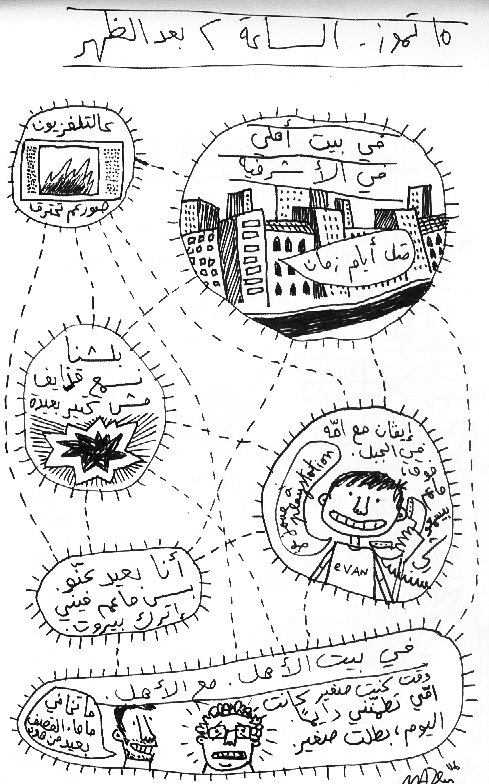
 (image by Mazen Kerbaj, from his blog )
I am such a slacker when it comes to writing. It always seems to difficult to finish things. There are so many ideas and interesting questions popping up once in a while, yet I never get to write them down. I'm living in a state of a life-long writer's block, I fear. As you could see, I have quite negelected my Moers Festival reviews in the past days. And today another idea had formed, the idea for an essay about a) music in times of war and b) whether the context of a musical performance is part of the music. The latter question was formed (again) yesterday, when I listened (again) to a recording of Wilhelm Furtwängler conducting the Berlin Philharmonic Orchestra in 1942. They were playing Beethoven's 9th symphony. A piece that has been performed a thousand times before and a million times afterwards. So, nothing special. But wait. 1942? Berlin? At that time that was the headquarter of evil. At that time German evil was bringing a desastrous violent inhuman bloodshed over the world. And at that time a man named Furtwängler, who has been instrumentalized by the Nazis to show the world what a high-class cultural life there exists in Germany, makes a choir sing joyously: "Alle Menschen werden Brüder" ("All men become brothers"). What is that? Starry-eyed idealism, chuzpe, misunderstanding of facts, insanity, an act of resistance? It's hard to say without doing a very deep survey on that matter. Yet maybe the even more interesting question is: Is the Nazi- and wartime context an inseparable part of this performance? Can we understand the performance without considering the Second World War? Or is the contrary true: Do we have to try neglecting the circumstances and concentrate on the "absoluteness" of the music itself? The question not only arises in the 4th movement where the choir sings lyrics that are in stark contrast to Nazi ideology, but already in the instrumental movement before. The first movement seemed not to conflict with the Nazis and the wartime, as it was played rather muscularly, in a swashbuckling way. The second movement didn't make much impression on me. But then, the third movement is not just played in a very beautiful and tender way, but also in a way that seems to depict a free exchange of human spirits. So I feel the starkness of the 4th movement is already prepared in here, in a purely instrumental way. By the third movement we could say, the performance turns into an anti-Nazi demonstration, probably right under the eyes and ears of the Nazis who were sitting in the audience.
I remember the French professor and writer Adrien Finck has written a short essay about this performance ("Musica in Extremis"), published in the Révue Alsacienne de littérature 84 in 2003. I've got to find this again and re-read it to see if Finck can help me answer my questions.
And then, I've got to think on, about what options musicians do have if they live in a country ravaged by war. I remember Mazen Kerbaj's recording of a trumpet improvisation, played and recorded on his balcony in Beirut while Israeli bombs were dropping onto the town. There's no question about it: the context in general and the war in specific are part of the musical performance here. Yet is it so different from Furtwängler? Isn't the music in both cases competing with the war, isn't it fighting the war with its own means, only seemingly week, but infusing us with sparks of hope?
I would like to write an essay about the questions raised here, yet I fear I never will. I am such a slacker.


